

The Two Birthdays
The Christmas story is two different stories wearing one sweater.
Reasoned Reality is reader-supported. Everything I publish here is free, and it will stay that way. No paywall, no guilt, no collection plate asking for ten percent of your paycheck. What a subscription actually pays for is time: the reading, the fact-checking, and the hours it takes to do this honestly. If you want to help fund more of it, a subscription is exactly $6.66 a month. If you came out of evangelicalism like I did, you already get the joke. Either way, I am glad you are here.
We are taught that the four Gospels tell one harmonious account of the birth of Jesus. But only two of them mention his birth at all, and the two that do cannot agree on the decade, the hometown, the route, the family tree, or even whether anyone was in danger.
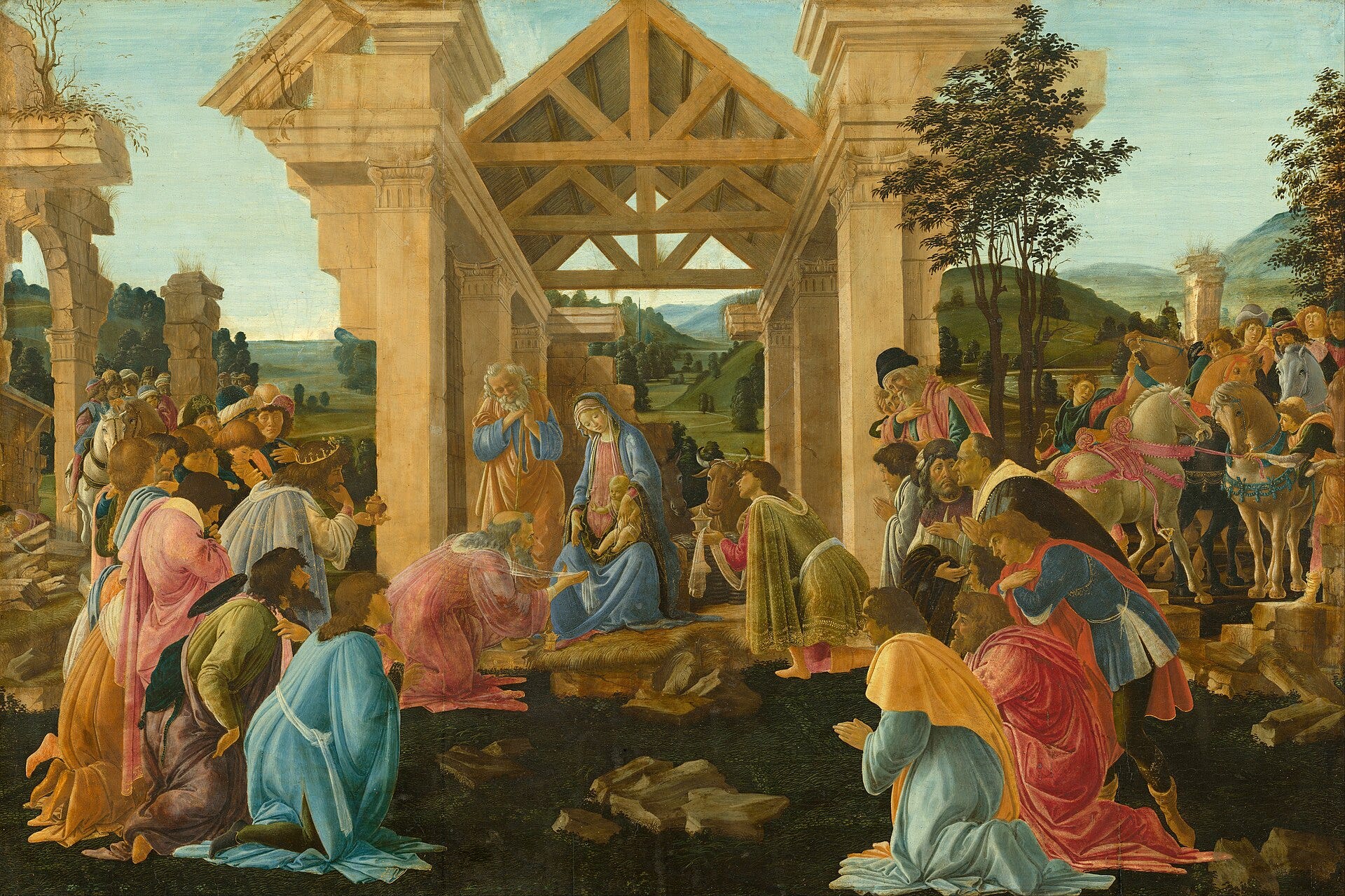
Every nativity scene you have ever seen is a quiet forgery. The wise men kneel on one side of the manger, the shepherds on the other, the star overhead, the whole cast assembled in a single frozen tableau. The problem is that no gospel ever puts them in the same room. The shepherds belong to one author. The wise men belong to a different author. The unified Christmas you grew up with is a centuries-old composite, two separate stories carefully stitched into one so the seams would not show.
Start with what is missing. Of the four Gospels, only Matthew and Luke describe a birth at all. The earliest Gospel, Mark, written around 70 CE, has no nativity, no Bethlehem, no virgin, no star. It opens with a grown man walking up to be baptized. The latest Gospel, John, written decades later, also skips the birth entirely and opens instead with a cosmic poem about the Word existing before creation. The two books that bracket the tradition, the first one written and the most theological one, show no awareness of a miraculous birth. If a virgin birth in Bethlehem were the well-known foundation of the faith, it is strange that the first biographer and the most elevated one both left it on the floor.
To see how deep the disagreement runs, we have to put the two surviving birth stories side by side and read them as the separate documents they are, rather than blending them on instinct the way a Christmas card does.
Begin with the timing, because the timing alone is fatal. Matthew, in his second chapter, places the birth squarely in the reign of Herod the Great. Herod is the villain of Matthew’s version, the king who hears of a newborn rival and orders the slaughter of the infant boys of Bethlehem. The historical problem is simple. Herod the Great is generally dated to have died in 4 BCE.
Luke, in his second chapter, anchors the birth to a completely different event. He says it happened during a census conducted when Quirinius was governor of Syria, a registration that required people to be enrolled. That census is a known, datable event. It took place in 6 CE, when Rome removed Herod’s son Archelaus, annexed Judea directly, and assessed the new province for taxation. That is about ten years after Herod the Great was already dead.
These two anchors cannot both be true. A single child cannot be born during the reign of a king who died in 4 BCE and also during a tax census that did not happen until 6 CE. The two authors have placed the same birth a full decade apart. That gap is not a rounding error. It means at least one of them is not working from history. He is working from theology, and reaching for a date that serves his story.
The census itself adds a second layer of trouble. Luke says the registration required Joseph to travel to Bethlehem because it was the town of his distant ancestor David, a thousand years earlier. But Roman censuses taxed people where they lived and owned property. They did not order the population to scatter across the empire to the villages of long-dead forefathers. A system that uprooted families to register in ancestral towns a millennium out of date would have been an administrative impossibility, and it matches no census in the historical record. It is a narrative device, and its single purpose is to move one family from Nazareth to Bethlehem.
That relocation is the engine driving both birth stories. Everyone knew Jesus came from Nazareth, an unremarkable village in Galilee. But scripture, in the book of Micah chapter five, said the coming ruler would come out of Bethlehem. So both Matthew and Luke had the same engineering task, to get a Nazarene born in Bethlehem, and each one solved it with a completely different mechanism.
Matthew solves it by assuming the family lived in Bethlehem from the start. In his version there is no journey at all. The family simply has a house there. Wise men follow a star to that house, a paranoid Herod orders his massacre, and the family flees south into Egypt to escape it, returning only after Herod dies and then settling in Nazareth almost by accident, which Matthew presents as the fulfillment of yet another prophecy.
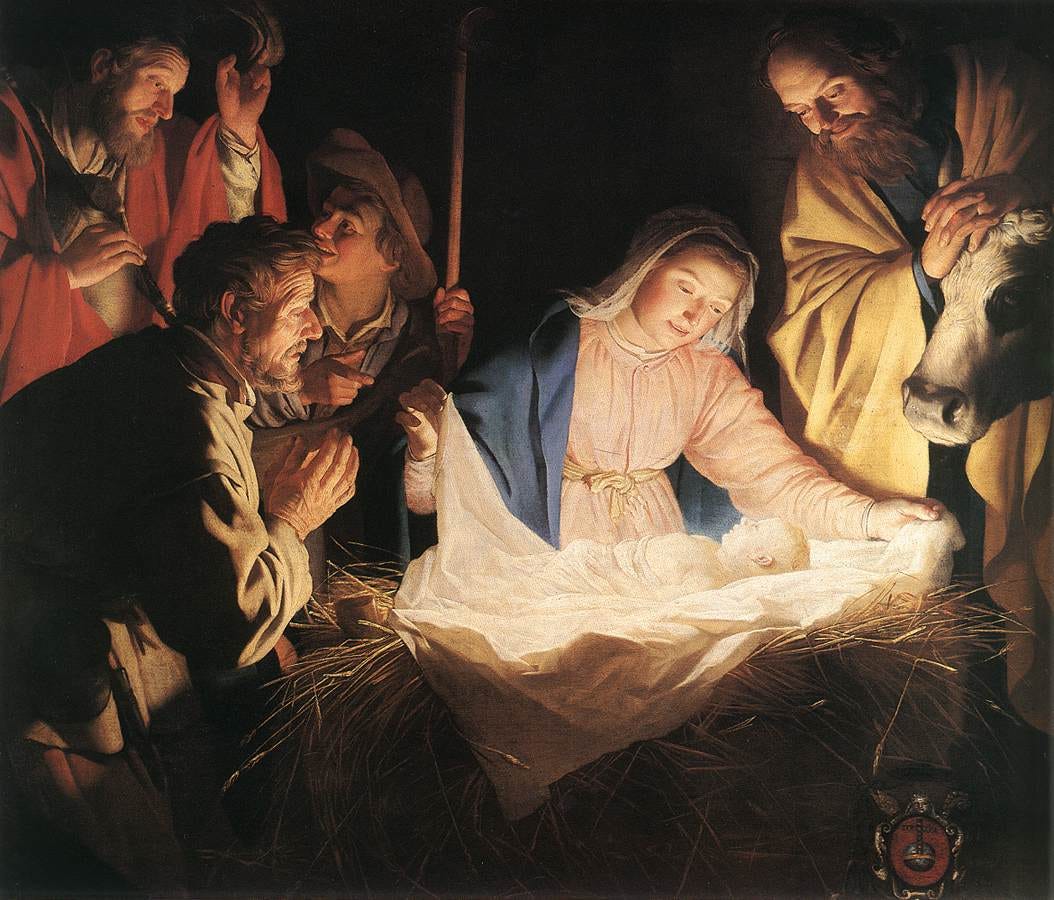
Luke solves the same problem by running the map in reverse. In his version the family already lives in Nazareth and is pulled down to Bethlehem only temporarily by the census. There are no wise men, no star, no jealous king, and no massacre. Instead there are shepherds in the fields, an angelic announcement, a manger, and a calm presentation of the baby at the Temple in Jerusalem, after which the family travels home to Nazareth without incident.
These itineraries do not merely differ in detail. They are mutually exclusive. In Matthew the family is in Bethlehem, flees to Egypt, and ends up in Nazareth as refugees from a king trying to kill the child. In Luke the family starts in Nazareth, travels to Bethlehem, goes to Jerusalem, and returns to Nazareth, with no Egypt, no threat, and no flight. You cannot run both routes on the same family in the same months. One says they escaped a murderer into a foreign country. The other says they ran a quiet errand and went home.
Then there is the family tree, where the two authors break in a way no amount of harmonizing can repair. Both open with a genealogy of Jesus, and the two lists do not match. Matthew traces the royal line from David through his son Solomon. Luke traces it from David through a different son named Nathan. The names diverge almost immediately and stay divergent for generations. The lists do not even agree on the name of Joseph’s own father. Matthew calls him Jacob. Luke calls him Heli.
Matthew’s genealogy also shows its construction openly. He announces that there are fourteen generations from Abraham to David, fourteen from David to the exile, and fourteen from the exile to the Messiah, a tidy three-times-fourteen scheme. To make the math land, he simply leaves kings out. Between Joram and Uzziah he silently drops three rulers who appear in the Hebrew scriptures. The number fourteen is also the numerical value of the name David when its Hebrew letters are added up, which strongly suggests the whole list was shaped around a symbolic pattern rather than copied from a record. A lineage edited to hit a number is a theological design, not a birth certificate.
There is a further irony buried in both genealogies. Each one carefully traces the bloodline through Joseph in order to connect Jesus to the royal house of David. Yet both authors also insist that Joseph was not the biological father, because of the virgin birth. So the very pedigree that supposedly makes Jesus the rightful heir of David runs entirely through a man the same texts say did not father him.
One more silence deserves attention. Matthew’s signature scene, Herod murdering all the baby boys of Bethlehem, appears in no other source. The most detailed surviving history of Herod’s reign records his cruelties in obsessive detail, including the executions of members of his own family, yet says nothing about the slaughter of every infant in a town. An atrocity that memorable, missed by the very chronicle most eager to expose Herod’s crimes, looks far more like a deliberate echo of the Moses story, in which a tyrant kills Hebrew infants, than a remembered event.
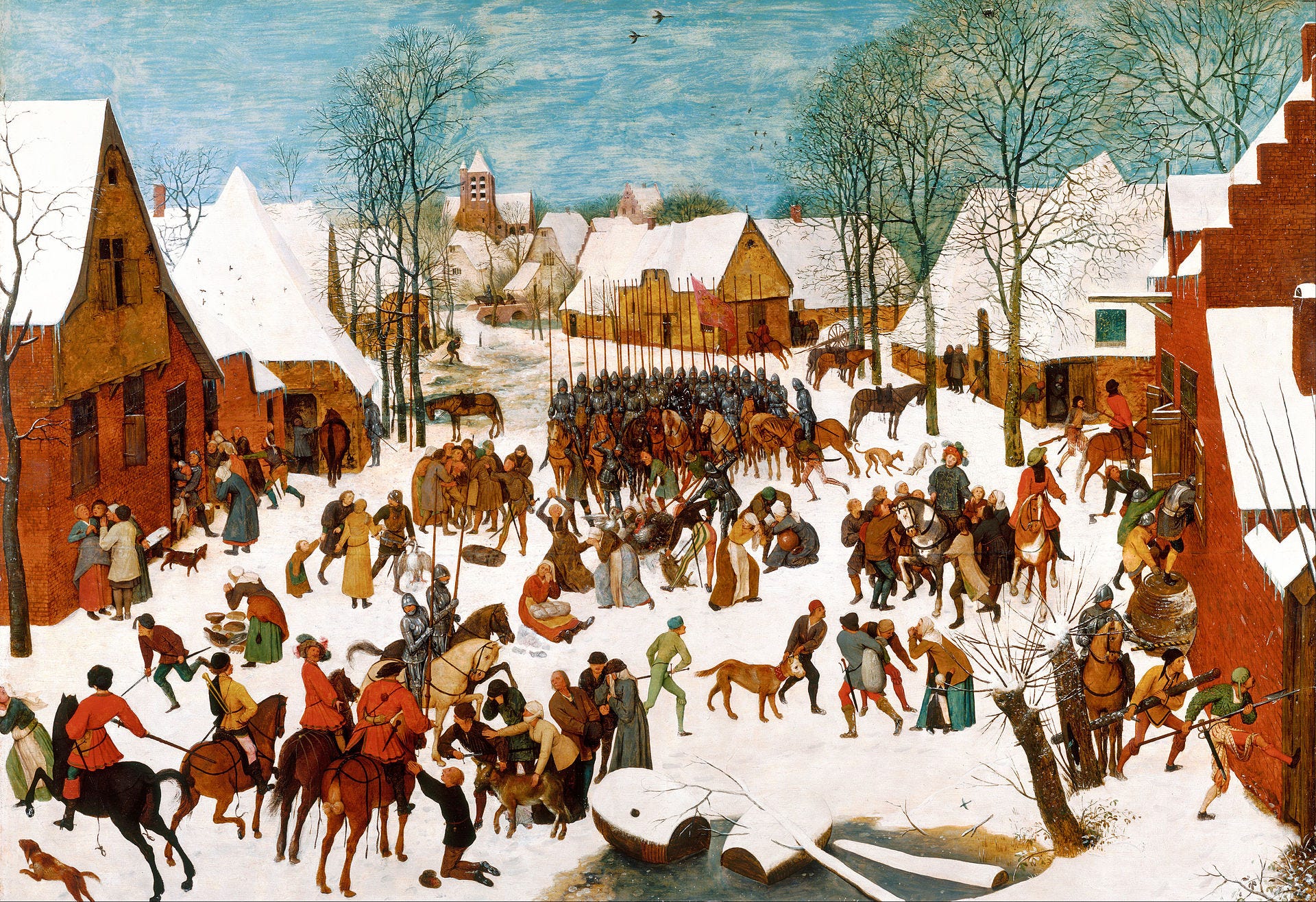
There is even a problem hiding inside Matthew’s own clue about timing. Herod, in that story, orders the killing of boys two years old and under, based on what the wise men told him. That detail implies the child could have been as much as two years old when the magi arrived, which sits awkwardly against the tidy image of newborns and a single silent night. The authors were not coordinating. They were each building a case.
Stand back from the two accounts and the pattern is unmistakable. Two different writers, working in two different communities, inherited the same awkward fact, that their Messiah came from the wrong town, and each solved it with a story the other had clearly never heard. One built a drama of stars, foreign sages, a murderous king, and an exile in Egypt. The other built a gentle scene of a census, a stable, and singing shepherds. Later tradition simply glued the two together and hung them on the wall as one picture.
When two accounts cannot share a decade, a hometown, a travel route, or a grandfather, the honest word for the result is not harmony. It is invention. The Christmas story is not one memory told twice. It is two arguments for the same conclusion, and the conclusion was decided before either story was written.
Recognizing this does not have to strip the season of its warmth or its meaning for the people who love it. But it does require us to be honest about what the nativity actually is. It is not a remembered event reported by witnesses. It is a theological claim, dressed up twice, in two costumes that do not fit on the same body.
Sources & Further Reading
The Birth of the Messiah by Raymond E. Brown (a Catholic priest and scholar whose exhaustive study lays out the conflicts between Matthew and Luke with complete candor).
The First Christmas by Marcus J. Borg and John Dominic Crossan (on how the two nativity narratives function as parable rather than reportage).
Jesus, Interrupted by Bart D. Ehrman (a clear walkthrough of the dating problem, the census, and the conflicting genealogies).
The Antiquities of the Jews and The Jewish War by Flavius Josephus (the detailed first-century histories of Herod’s reign that record his atrocities but no massacre of Bethlehem’s infants).
Reasoned Reality is reader-supported. This work stays free because the people who need it most are often the ones who can least afford one more subscription. If you are able to chip in and keep it running, $6.66 a month buys the time it takes to keep digging. If not, read freely and share widely. I am grateful you are here, no matter what.