
The Synoptic Photocopy
Why You Don't Have Four Independent Witnesses
Reasoned Reality is incredibly important to me. You will never see a collection plate passed around here for ten percent of your hard-earned money. This historical information should be accessible to everyone. But if you are able to chip in, a monthly subscription of exactly $6.66 is a great way to support. If you are an exvangelical, like myself, you’ll understand my subscription price😊
I am so grateful to have you here, no matter what.
We are taught that the four Gospels are four independent witnesses whose corroborating testimony confirms the historical reliability of the life of Jesus. But when you compare them line by line in the original Greek, you find a documented case of literary copying, not independent reporting.
The four-witness defense is one of the most common arguments offered for the trustworthiness of the New Testament. We are told that Matthew, Mark, Luke, and John each provide a separate, eyewitness-based account of the same events, and that the small differences between them are exactly what you would expect from honest, independent observers describing the same scene from different angles. Pastors and apologists invoke this idea constantly. The four Gospels are presented as four legs of a sturdy historical table.
It is a clean, lawyerly, and intuitive argument. But there is a massive textual problem with this tidy storyline.
When you set the Greek manuscripts of Matthew, Mark, and Luke side by side and read them in parallel, the picture is not four people independently describing the same event. It is one author writing first, and the next two using his work as a literary template, copying enormous amounts of his text word for word, while editing his theology and inserting their own additions. The Gospels are not independent witnesses. They are documented descendants of a shared written source. This is one of the most thoroughly established findings in modern biblical scholarship, and it has its own technical name. It is called the Synoptic Problem.
To understand how this works, we have to start with the chronology of the texts.
Mark is the earliest of the four Gospels. Critical scholars across Catholic, Protestant, Jewish, and secular institutions place its composition around 70 CE, roughly forty years after the crucifixion. Matthew was written ten to fifteen years later. Luke followed in the same period or slightly after. John, the latest, was composed near the end of the first century. The phrase “Synoptic Gospels” refers specifically to Matthew, Mark, and Luke, because they can be set in parallel columns and “seen together,” sharing huge swaths of identical material in a way the Gospel of John does not.
The numbers are striking. Out of the 661 verses in the Gospel of Mark, somewhere between 600 and 610 of them appear in the Gospel of Matthew. Roughly 350 of them appear in the Gospel of Luke. In many of those passages, Matthew and Luke do not just share the same story. They share the exact same Greek vocabulary, in the exact same word order, including the same conjunctions and the same minor grammatical quirks. They do not paraphrase. They copy.
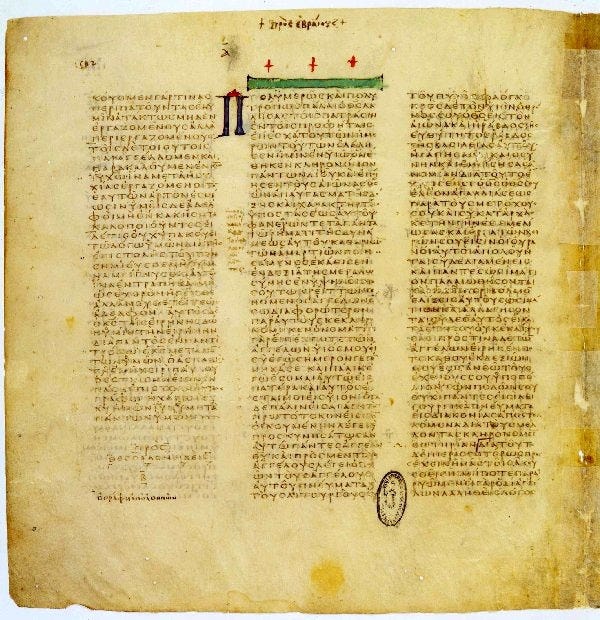
This is not a phenomenon that happens when independent witnesses describe a shared event. Two people watching a car accident will describe it in their own words, with different details, in different sentence structures. They will not, by coincidence, produce identical Greek paragraphs forty years later. What you see in the Synoptic Gospels is the unmistakable signature of literary dependency, the same signature you would see if a student copied a paragraph from an encyclopedia and changed only a few words.
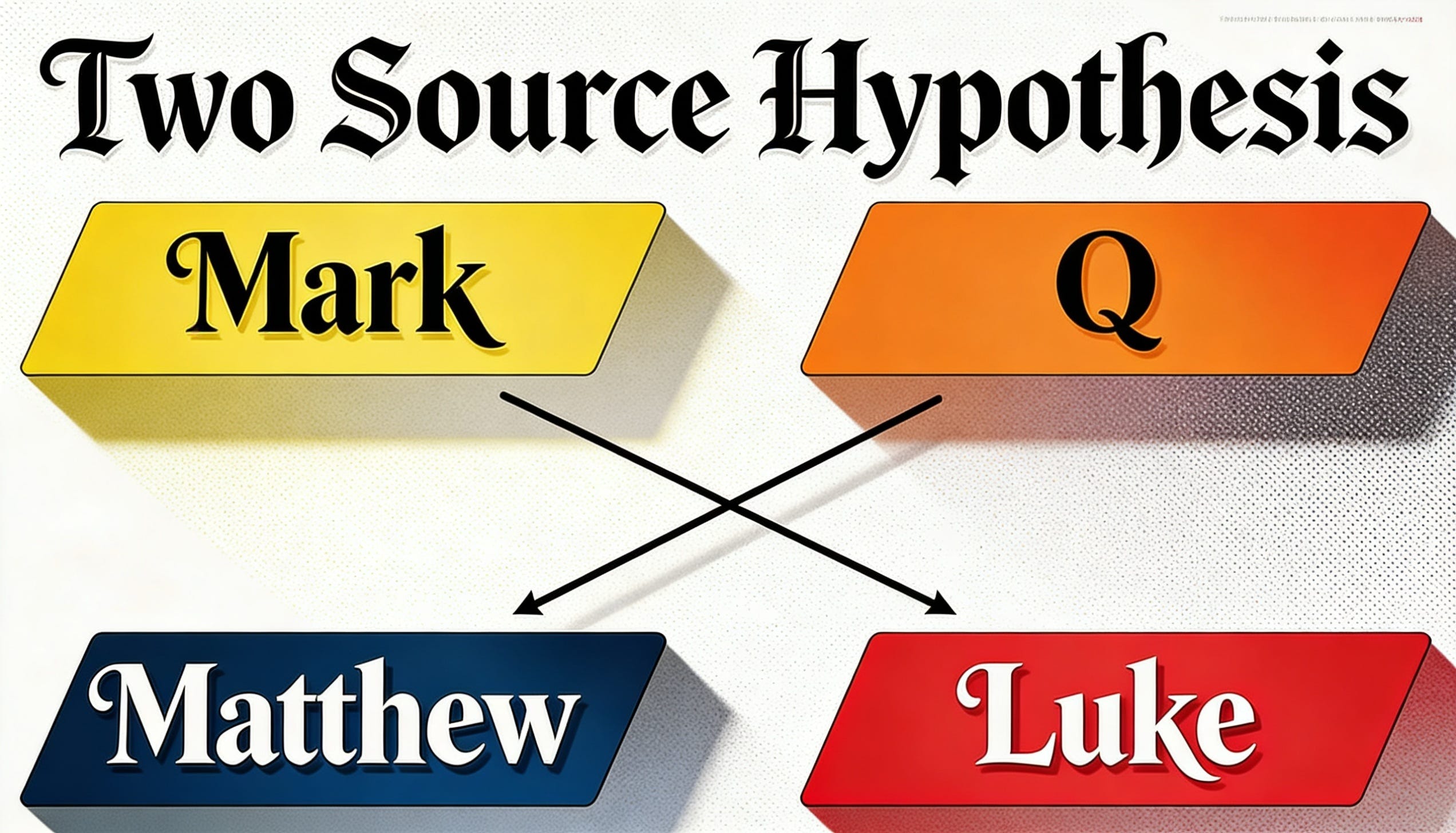
There is also a second pattern. Matthew and Luke share a large block of additional material that does not appear in Mark. This material is mostly composed of sayings of Jesus, including major sections of the Sermon on the Mount, the Lord’s Prayer, the Beatitudes, and parables like the lost sheep. When you compare these passages, Matthew and Luke again share extensive verbatim Greek wording, but they organize and arrange the material differently. Scholars call this hypothetical shared sayings source “Q,” from the German word Quelle, meaning “source.”
The dominant scholarly model, called the Two-Source Hypothesis, holds that Matthew and Luke each had two written documents in front of them. One was the Gospel of Mark. The other was the Q sayings collection. They each rewrote and rearranged this material, added their own unique stories, and produced their own Gospel. This is not a fringe theory. It is the standard model taught in every reputable seminary and university New Testament course in the world, including Catholic ones.
The implications for the four-witness argument are severe.
If Matthew and Luke are using Mark as a written source, then the supposed corroboration between them is not corroboration at all. It is the same testimony being reproduced. When Matthew, Mark, and Luke all report a particular healing or parable, you are not hearing three independent witnesses agree. You are hearing one witness, Mark, repeated three times with edits. The agreement of the three Synoptics on a given event tells us only that Matthew and Luke kept that line from Mark. It tells us nothing about whether the underlying event actually occurred.
This is exactly the kind of evidence that would never be accepted in a court of law. If three witnesses gave testimony, and it was discovered that two of them had been reading from a transcript prepared by the third, their testimony would be merged into one and treated with much greater caution. That is the actual situation with the Synoptic Gospels.
The case becomes even clearer when you watch what Matthew and Luke do with Mark’s material. They do not preserve it as untouchable scripture. They edit it. They smooth out his rough Greek. They quietly correct his geographical mistakes. They soften his portrayal of the disciples, who in Mark are repeatedly clueless and afraid. They upgrade his Christology, sharpening Jesus’ divinity. They sometimes change theologically uncomfortable lines outright. In Mark, Jesus is asked, “Why do you call me good? No one is good except God alone.” In Matthew, the same scene is rewritten so that Jesus instead says, “Why do you ask me about what is good?” The shift is small. The motive is obvious.
This is the behavior of editors and theologians, not of independent eyewitnesses.
How could a tradition that insists on four corroborating accounts have grown out of a clear case of literary copying?
The answer is the long delay between the events and the writing.
Jesus was crucified around 30 CE. The first Gospel was not written for forty years. During that forty-year window, the stories about Jesus circulated orally inside an expanding Greek-speaking church. By the time Mark sat down to write, much of the original generation was dying off, scattered by war, or persecuted. Mark anchored the tradition into a single text. Matthew and Luke then used that anchor and the Q collection to produce their own theologically distinct versions for their own communities. By the time the four-Gospel canon was assembled in the late second century, the literary relationship had been forgotten and the four texts were re-presented as four independent voices.
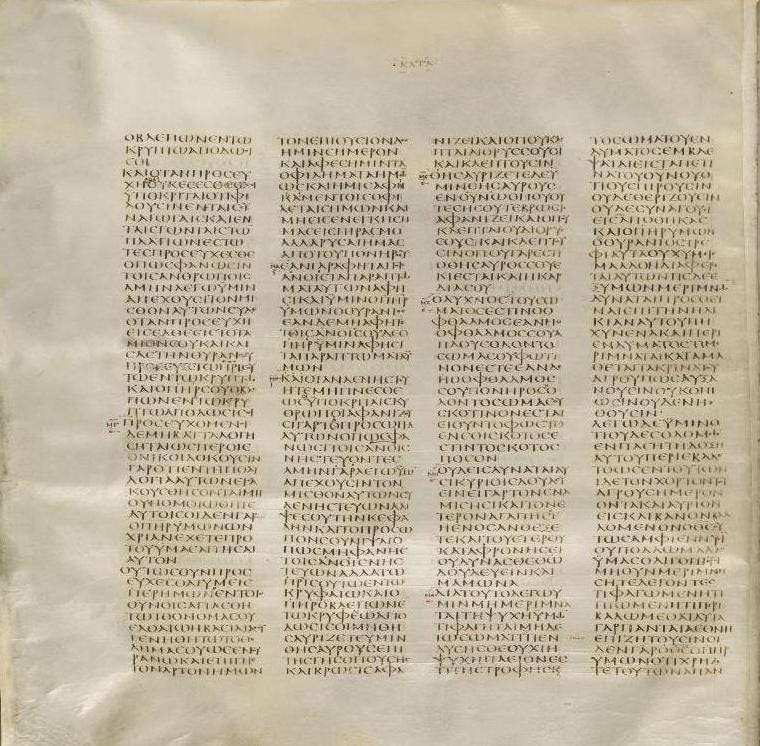
The familiar image of four eyewitnesses giving complementary testimony does not survive contact with the actual Greek manuscripts. It began with one author writing in the late first century. It evolved into two more authors using his work as a template. It was decorated with shared sayings borrowed from a now-lost source. And it was ultimately marketed, centuries later, as four-fold confirmation of a story that is, on the page, one source repeated.
Recognizing this literary lineage does not have to destroy the value the Gospels have as religious literature. But it does require us to be honest about the copied, edited, and theologically motivated origins of the texts that still anchor the largest religion on earth.
Sources & Further Reading
The Synoptic Problem: A Way Through the Maze by Mark Goodacre (A clear, accessible introduction to the literary relationships between Matthew, Mark, and Luke).
Jesus, Interrupted: Revealing the Hidden Contradictions in the Bible (And Why We Don’t Know About Them) by Bart D. Ehrman (A bestselling overview of how mainstream biblical scholarship reads the Gospels as literary, not independent, documents).
A Marginal Jew: Rethinking the Historical Jesus (multi-volume series) by John P. Meier (A Catholic priest and rigorous historical-critical scholar’s deep treatment of the source dependencies behind the Gospels).
You will never see a collection plate passed around here for ten percent of your hard-earned money. This historical information should be accessible to everyone. But if you are able to chip in, a monthly subscription of exactly $6.66 is a great way to support.
Christianity isn't the "largest religion on earth" since they are splintered into many fragments that are quite sure that the others aren't actually christians at all.