
The Resurrection Drift
Watching Easter Grow in Real Time
Reasoned Reality is incredibly important to me. You will never see a collection plate passed around here for ten percent of your hard-earned money. This historical information should be accessible to everyone. But if you are able to chip in, a monthly subscription of exactly $6.66 is a great way to support. If you are an exvangelical, like myself, you’ll understand my subscription price😊
I am so grateful to have you here, no matter what.
We are taught that the resurrection of Jesus is the unshakable historical event at the center of Christianity. But when you read the New Testament documents in the order they were actually written, you can watch the story grow, branch, and contradict itself in real time.
The resurrection is the load-bearing claim of the entire Christian faith. The Apostle Paul stated it plainly when he wrote that if Christ has not been raised, the entire faith is empty. We are told from childhood that four independent witnesses, the four Gospels, all confirm the same essential event. A tomb was found empty. Jesus appeared, in the flesh, to his disciples. The Christian church was born from a single, undeniable, supernatural moment in history.
It is a powerful, simple, and unified narrative. But there is a massive textual problem with this tidy storyline.
When you stop reading the Gospels in their printed canonical order and start reading them in the order they were actually composed, the resurrection narrative does not stand still. It expands. New witnesses appear. New locations are added. New angels arrive. The original ending fades and a longer ending is grafted on. By the time the story reaches its final form, it looks almost nothing like its earliest version. The resurrection story we inherit is not one event reported four times. It is one rumor revised and amplified across roughly seventy years.
To understand how this works, we have to start with the earliest Christian source we possess.
The earliest written reference to the resurrection is not found in the Gospels. It is found in the letters of Paul, written between roughly 50 and 58 CE, two decades before any Gospel was composed. In 1 Corinthians 15, Paul lists the resurrection appearances he knows about. He says Jesus appeared to Peter, then to the twelve, then to over five hundred people at once, then to James, then to all the apostles, and finally to Paul himself.
Notice what is missing from this earliest list. There are no women at the tomb. There is no empty tomb at all. There is no mention of Mary Magdalene, no angels, no rolled-away stone, no Galilean appearance, no Emmaus walk, no doubting Thomas, no fish breakfast on the beach. Paul, writing closest in time to the actual events, has none of the iconic scenes that modern Christians associate with Easter morning. He has only a list of names of people who claimed to have seen the risen Christ in some unspecified manner.
The next layer is the Gospel of Mark, written around 70 CE.
Mark is the first Gospel ever composed. And in the earliest, most reliable manuscripts, Mark ends at chapter 16, verse 8. Three women arrive at the tomb. The stone is already rolled away. A young man in a white robe tells them Jesus has been raised and that they should go tell the disciples to meet him in Galilee. The women flee, terrified, and tell no one. That is the entire ending. There are no resurrection appearances. There is no encounter with Jesus. There is no Great Commission. The text simply stops.
The longer ending of Mark, verses 9 through 20, which describes Jesus appearing to Mary Magdalene and to the disciples, is missing from the oldest and best Greek manuscripts. Even most modern Bibles flag it in a footnote as a later addition. The earliest Christian community, reading the earliest Gospel, encountered a resurrection without a single physical appearance of Jesus.
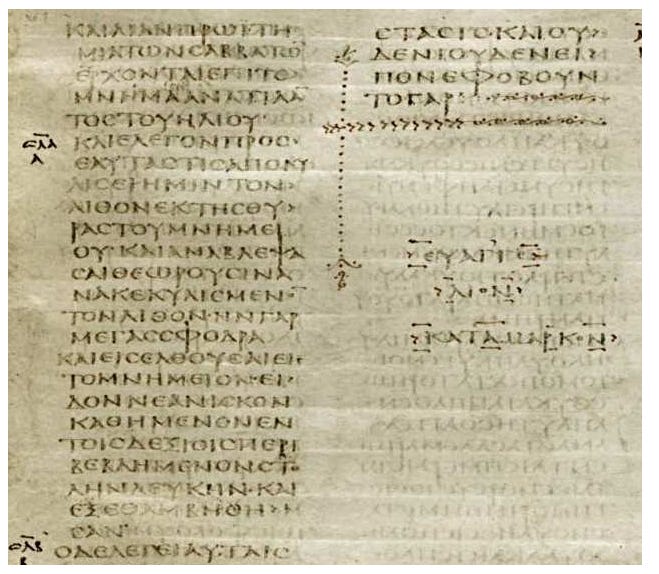
The next layer is Matthew, written around 80 to 85 CE.
Matthew clearly has Mark in front of him as a source, but he is not satisfied with Mark’s silence. Matthew adds an earthquake. He adds a glowing angel descending from heaven and rolling back the stone in front of the women. He adds Roman guards, who are then bribed to lie. He adds an appearance of Jesus to the women on the road. He adds a final mountain-top appearance in Galilee where Jesus delivers the Great Commission. Where Mark had a quiet, ambiguous, terrifying ending, Matthew supplies a cinematic resolution.
The next layer is Luke, written around 85 to 90 CE.
Luke moves the resurrection appearances out of Galilee entirely and relocates them to Jerusalem and the surrounding region. Luke introduces the Emmaus road encounter, where two disciples walk with a stranger who is later revealed to be Jesus. Luke adds a scene where Jesus eats a piece of broiled fish in front of the disciples to prove he is not a ghost. Luke also writes the sequel, the book of Acts, in which he tells the resurrection story a second and a third time, with different details each time, including different versions of how Judas died and where Jesus ascended.
The final layer is the Gospel of John, written between 90 and 110 CE.
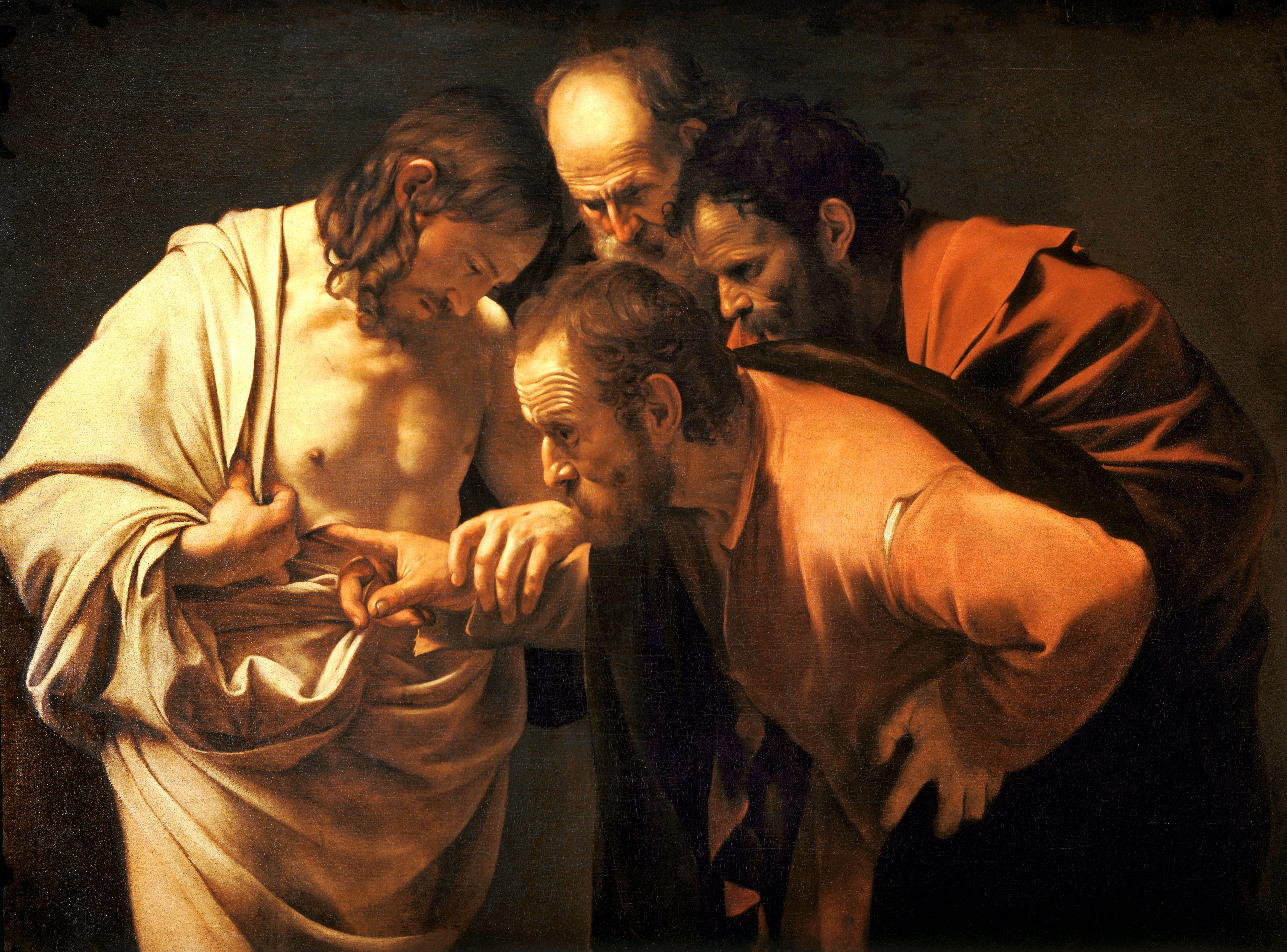
By this point, sixty to eighty years have passed since the crucifixion. John offers the most elaborate resurrection narrative in the entire New Testament. He gives us Mary Magdalene mistaking Jesus for the gardener. He gives us the footrace of Peter and the Beloved Disciple to the empty tomb. He gives us doubting Thomas, who must be invited to put his hand into Jesus’ wound to believe. He gives us the miraculous catch of one hundred fifty-three fish on the shore of Galilee, followed by a private conversation between Jesus and Peter. None of this material exists in any earlier source.
Stand back from the four accounts and the pattern is unmistakable.
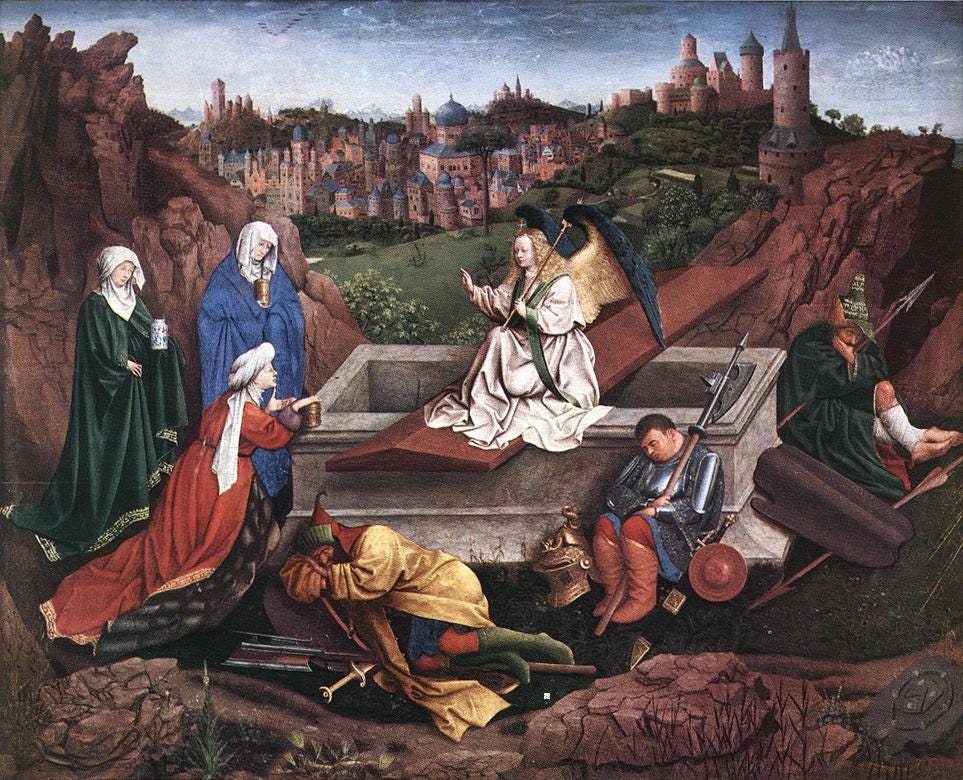
How many women came to the tomb? Mark says three. Matthew says two. Luke says a group including at least five. John says one. Did they meet a young man, an angel, two angels, or no angels? The four texts each give a different answer. Did the disciples see Jesus in Galilee, or only in Jerusalem? Matthew and Mark place the appearances in Galilee. Luke places them in Jerusalem and explicitly tells the disciples to stay in the city. John tries to do both. Was the risen Jesus a physical body that ate fish and could be touched, or a being that passed through locked doors and was not always recognizable to people who had known him? The Gospels say all of these things, often on the same page.
The resurrection narrative did not emerge from the empty tomb fully formed. It emerged from a forty-year process of oral retelling, theological reflection, and competitive storytelling. Paul has only a list of names. Mark has a vacant tomb and silent women. Matthew bolts on guards and earthquakes. Luke adds road conversations and shared meals. John supplies the most physical, the most theological, and the most miraculous version of all.
The resurrection story did not stay still long enough to be a single historical event. It grew with the church, evolved with the audience, and was edited by the needs of each new generation. It began with a list. It evolved into an empty tomb. It was decorated with guards and angels. And it was ultimately rewritten into a fully embodied, mountaintop, locked-room, beachside drama.
Recognizing this textual evolution does not have to destroy the spiritual meaning that millions of people draw from the Easter story. But it does require us to be honest about the layered, contested, and visibly developing origins of the central claim that built the largest religion in human history.
Sources & Further Reading
How Jesus Became God: The Exaltation of a Jewish Preacher from Galilee by Bart D. Ehrman (A historical reconstruction of how the resurrection claim evolved across the earliest Christian sources).
The Resurrection of the Son of God by N. T. Wright (A massive, conservative scholarly defense of the resurrection that nonetheless documents in detail the differences between the Gospel accounts).
The Empty Tomb: Jesus Beyond the Grave edited by Robert M. Price and Jeffery Jay Lowder (A rigorous critical examination of the historical and literary problems with the resurrection narratives).
You will never see a collection plate passed around here for ten percent of your hard-earned money. This historical information should be accessible to everyone. But if you are able to chip in, a monthly subscription of exactly $6.66 is a great way to support.