

The Geographic Lottery
Why Your Religion Is a Function of Your Birth Address
Reasoned Reality is incredibly important to me. You will never see a collection plate passed around here for ten percent of your hard-earned money. This historical information should be accessible to everyone. But if you are able to chip in, a monthly subscription of exactly $6.66 is a great way to support. If you are an exvangelical, like myself, you’ll understand my subscription price😊
I am so grateful to have you here, no matter what.
We are taught that we hold our religious beliefs because they are true. But when you look at the global data, the single most powerful predictor of which “true” faith a person professes is the geographic and cultural accident of where they happened to be born.
Most people, in most places, in most centuries, have been very confident that their religion is correct. Christians know that Jesus is the way. Muslims know that Muhammad is the seal of the prophets. Hindus know that the Vedas describe reality. Orthodox Jews know that the Torah is divinely revealed. Theravada Buddhists know that the Pali Canon contains the Buddha’s authentic teaching. We are told, inside each tradition, that this confidence reflects access to a deeper truth.
It is a powerful, sincere, and deeply held conviction. But there is a massive statistical problem with this storyline.
When you zoom out from any single tradition and look at the global distribution of religious belief, a very uncomfortable pattern emerges. Religious affiliation is not randomly scattered across the planet. It is not correlated with intelligence, with study, with moral effort, or with rigorous comparative investigation. It is correlated, with stunning precision, with where on the map a person’s mother happened to be standing when she gave birth. The same human, with the same brain, raised in a different country, would almost certainly profess a different faith and feel exactly the same certainty about it.
To understand how this works, we have to start with the actual numbers.
Pew Research, the Association of Religion Data Archives, and the World Religion Database all converge on the same picture. Roughly eighty-five percent of people on Earth identify with a religion. The single best predictor of which religion they identify with is not theology. It is geography. A child born in Saudi Arabia has a roughly ninety-nine percent chance of growing up Muslim. A child born in Thailand has a similar likelihood of growing up Buddhist. A child born in rural Mississippi has overwhelming odds of growing up Christian. A child born in Israel into an Orthodox Jewish family has overwhelming odds of growing up Orthodox Jewish.
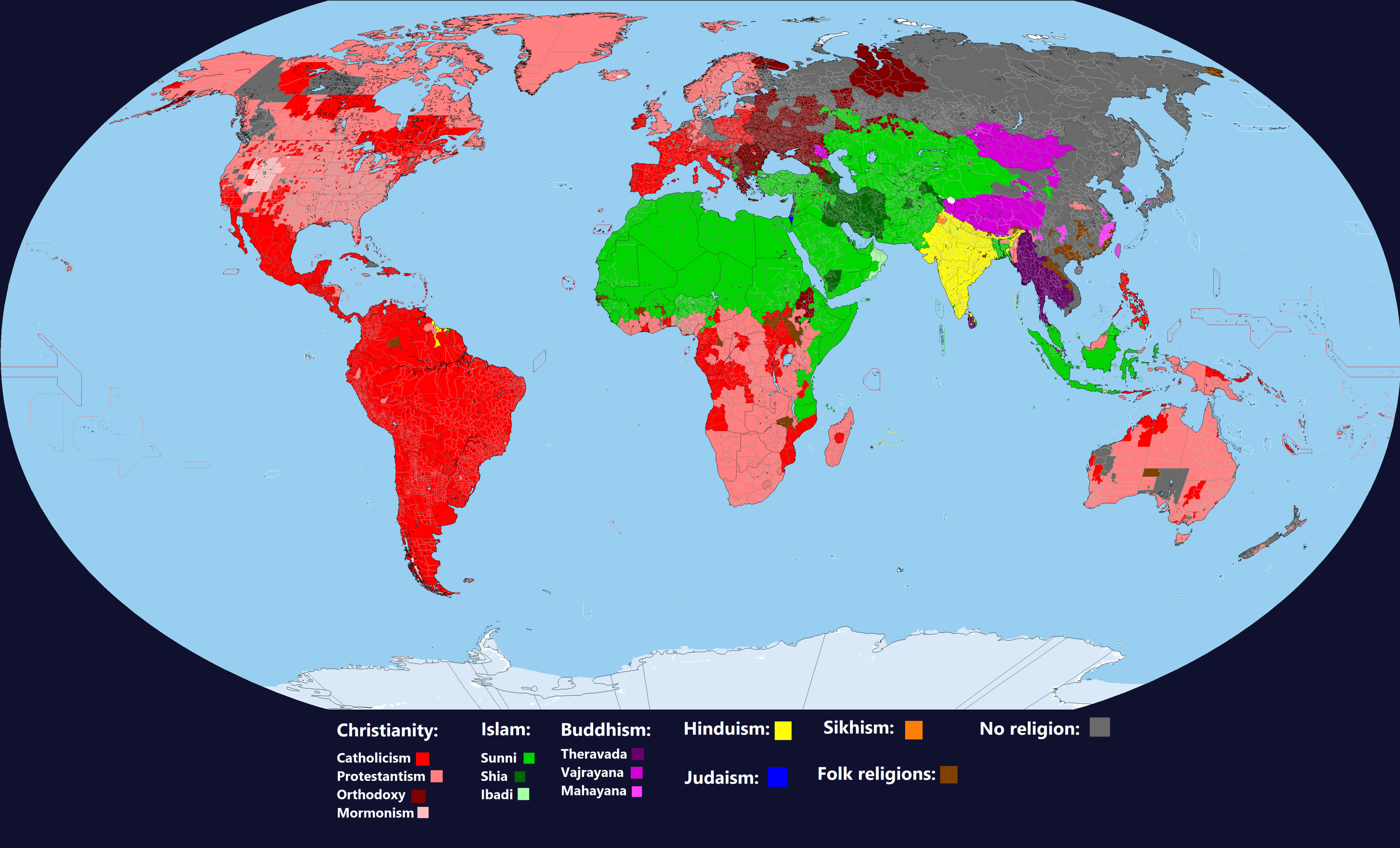
These probabilities do not move because the local religion has been independently verified. They move because human beings inherit the religion of their parents, their neighborhood, their schoolteachers, and their state. Religion behaves the way language behaves. People who are born in Tokyo speak Japanese, not because Japanese is the most metaphysically true language, but because that is what was spoken around them when their brains were learning to speak.
The same pattern holds at every scale you measure it.
Within the United States, the Bible Belt is not Bible-Belt because southerners independently studied comparative theology and concluded that Southern Baptist Christianity was the truest expression of ultimate reality. It is Bible-Belt because of historical migration patterns, the Second Great Awakening, the legacy of slave-era plantation Christianity, and the regional persistence of evangelical institutions over generations. Within Catholicism, the strongest predictor of which Marian apparition a believer treats as most authoritative is which country produced it. Mexicans gravitate toward Guadalupe. Portuguese toward Fátima. French toward Lourdes. Within Islam, the boundary between Sunni and Shia majority populations is drawn by political history and conquest, not by independent revelation reaching the right ears.
Religion behaves like a heritable cultural trait, not like a discoverable truth.
How can a tradition claim to be the universally accessible saving truth if access to that truth is so transparently a function of one’s mailing address?
The answer most religions historically gave was conquest and conversion.
For most of human history, the dominant strategy for fixing the geographic problem was simply to use political and military power to extend the home religion across the map. Roman Christianity expanded with the Roman state. Islam expanded under the early caliphates and the Ottoman Empire. Spanish Catholicism rolled across the Americas behind Spanish soldiers. Protestant missionaries traveled with British colonial administrators. The current map of world religion is largely a frozen snapshot of past military and economic power, not a record of which truth claims actually persuaded honest seekers.
This is why the historical correlation runs in only one direction. Religions that won wars and built empires now have a billion adherents. Religions that lost wars or never built empires died out or remain small, regional traditions. Manichaeism was once a global religion stretching from Spain to China. It is now extinct. Zoroastrianism, which directly influenced Jewish, Christian, and Islamic ideas about heaven, hell, angels, and a final judgment, has fewer than two hundred thousand living adherents. The size of a faith on the modern map is not a measure of its truth. It is a measure of which armies and which translation programs reached the most villages first.

There is a clean thought experiment that exposes this pattern.
Imagine taking a newborn Saudi infant and a newborn Thai infant and switching them at birth. The Saudi-born baby, raised in Bangkok by a Thai Buddhist family, will grow up reciting Buddhist scripture, lighting incense at temple, and feeling the deep certainty that the Pali tradition speaks truth. The Thai-born baby, raised in Riyadh by a Saudi Muslim family, will grow up praying five times a day toward Mecca, fasting during Ramadan, and feeling the deep certainty that Islam is the final and complete revelation. The babies do not change. The same human consciousness, dropped into different cultural water, fills the same shape.
That thought experiment is not just hypothetical. It is what actually happens to every infant born on this planet, every day, in every culture. They do not arrive in the world with a religion. They are assigned one by the people and place around them.
This does not prove that any specific religion is false. It does prove something more uncomfortable. It proves that the confidence a believer feels in their own religion is not, on its own, evidence that the religion is true. The exact same confidence is felt, in the exact same intensity, by people who hold contradictory beliefs in different parts of the world. Confidence cannot be the test, because confidence is uniformly distributed across mutually exclusive faiths.
The map of human religion did not arise because seekers in every village independently arrived at the same conclusions. It arose because babies absorb the worldview of their first caretakers. It evolved because empires and missionaries extended that worldview by force or by economic incentive. It was decorated with the certainty that the local tradition is uniquely true. And it was ultimately presented, inside each region, as the obvious and self-evident description of reality, despite the fact that the same claim is being made on every other continent.
Recognizing this geographic pattern does not have to dismantle whatever wisdom or community a person finds inside their own tradition. But it does require us to be honest about the inherited, contingent, and deeply human reasons that determine which faith we currently feel certain about.
Sources & Further Reading
The Global Religious Landscape (Pew Research Center, 2012, with subsequent updates) (The most-cited demographic mapping of world religion by country, age, and trajectory).
God Is Not One: The Eight Rival Religions That Run the World by Stephen Prothero (A comparative religion scholar’s evenhanded survey of how the major traditions actually differ from one another).
Religion Explained: The Evolutionary Origins of Religious Thought by Pascal Boyer (A cognitive anthropologist’s explanation of why the human mind so readily absorbs whatever religion happens to be in its environment).
You will never see a collection plate passed around here for ten percent of your hard-earned money. This historical information should be accessible to everyone. But if you are able to chip in, a monthly subscription of exactly $6.66 is a great way to support.