
The Flat Earth Bible
How the Cosmology of the Holy Book Got Built by People Who Thought the Sky Was a Dome
Reasoned Reality is incredibly important to me. You will never see a collection plate passed around here for ten percent of your hard-earned money. This historical information should be accessible to everyone. But if you are able to chip in, a monthly subscription of exactly $6.66 is a great way to support. If you are an exvangelical, like myself, you’ll understand my subscription price😊
I am so grateful to have you here, no matter what.
We are taught that the Bible is timeless and that its descriptions of the natural world are perfectly compatible with modern science. But when you read the cosmology of the text in its original Hebrew and Greek, you find a flat Earth, a solid sky, and a sun that pauses overhead, exactly matching the worldview of every Bronze Age culture in the region.
The Bible is regularly described, in apologetic literature and in pulpit teaching, as containing scientific accuracy that pre-dated modern discovery. Passages are quoted in support of the idea that scripture knew the Earth was a sphere, that it described the water cycle long before science did, and that its picture of the universe is broadly consistent with what astronomers and physicists understand today. We are told that any apparent conflict is the result of poetic language or our own misreading.
It is a smooth, conciliatory, and reassuring framing. But there is a massive problem with this storyline.
When you read the Hebrew Bible in its original language, and place it alongside surviving Babylonian, Egyptian, and Canaanite texts, the picture becomes unmistakable. The biblical authors believed in a flat Earth resting on pillars, covered by a solid metallic dome through which the sun, moon, and stars moved on tracks, with windows in the dome that opened to release rain from a cosmic ocean stored above. This is exactly what every other ancient Near Eastern people believed. It is not metaphor. It is not poetry. It is a serious, sincere, and shared model of the cosmos that scientific astronomy did not begin to dismantle until two thousand years later.
To understand how this works, we have to start with the very first verses of the Bible.
In Genesis chapter one, on the second day of creation, God creates a “firmament” to separate the waters above from the waters below. The Hebrew word translated as firmament is raqia. It comes from a verb that means to beat out or hammer flat, the same word used to describe the way a metalworker hammers a sheet of bronze into a thin, solid layer. The Septuagint translators rendered raqia into Greek as stereoma, meaning a hard, solid structure. The Latin Vulgate then translated it as firmamentum, which gave us the English word firmament. The translators across two languages and a thousand years all understood the original Hebrew the same way. The sky was a solid dome that had been physically beaten out and stretched across the Earth.
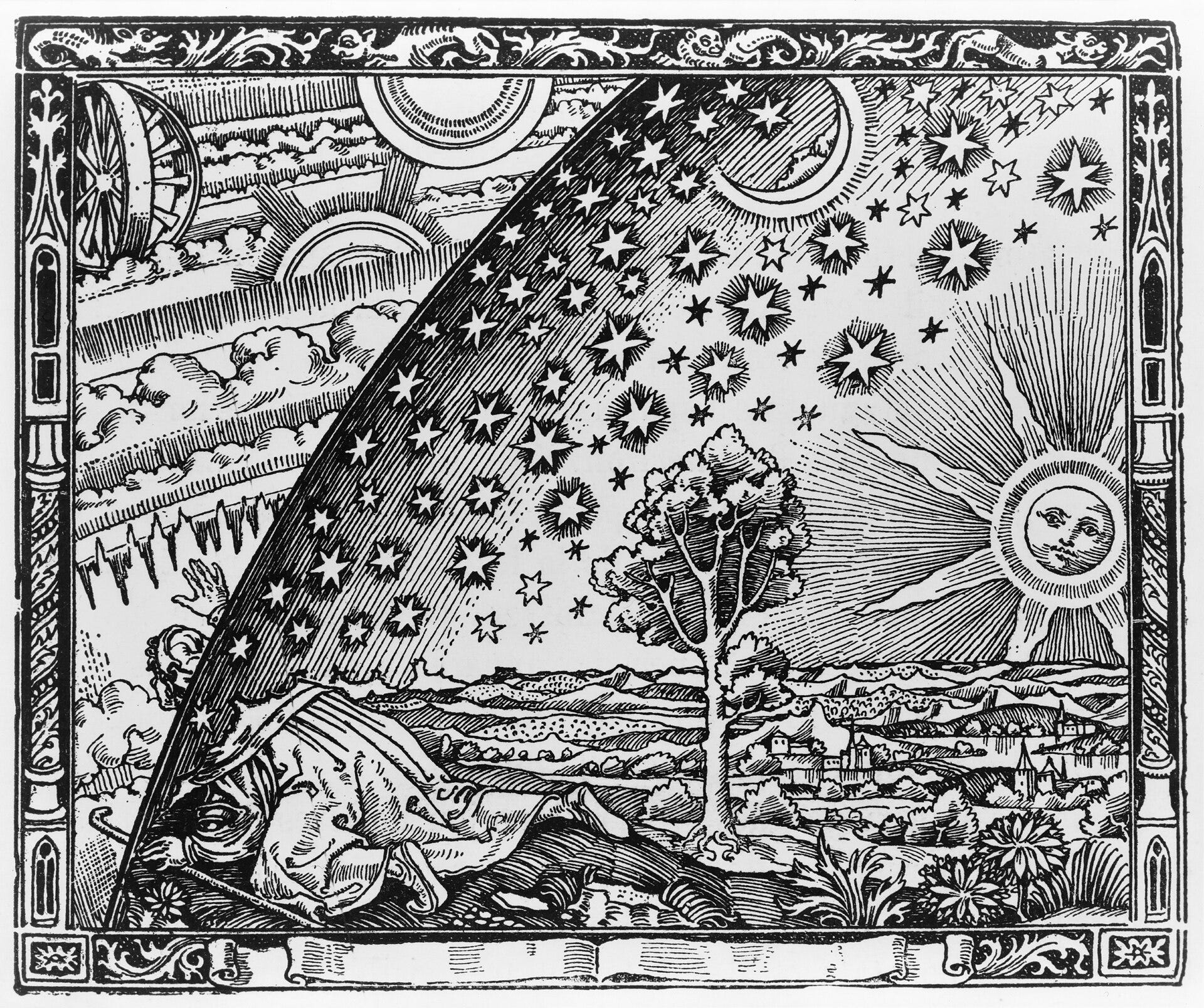
This is not a stray verse. It is the architecture of the entire biblical universe.
In Genesis chapter seven, when the great flood begins, the text says that “the windows of heaven were opened.” This is not metaphor. In the Hebrew cosmology, the rain falls because little hatches in the solid dome above the Earth are opened to let the cosmic ocean through. The same image reappears in Second Kings chapter seven, in Malachi chapter three, and in Isaiah chapter twenty-four. Rain is stored, in jars and reservoirs, above the firmament, and is released into the lower world through openings in the metal sky. Job chapter thirty-eight describes God asking who keeps these reservoirs, and the same chapter portrays the heavens as solid enough to be “molded” or “spread out as a molten mirror.”
Below the dome sits a flat Earth.
The Earth in biblical cosmology is not a sphere. It rests on “pillars” or “foundations,” explicitly described as such in First Samuel chapter two, in Job chapter nine, in the Psalms, and in the prophets. The pillars are anchored in the deep, a freshwater abyss beneath the dry land. The book of Revelation, written in the late first century, still depicts the Earth as flat with “four corners,” a phrase that also appears in Isaiah chapter eleven and that makes geographic sense only on a flat plane. Daniel chapter four describes a tree so tall that it could be seen “to the ends of the Earth,” which is a vivid line of poetry only if the planet is flat enough that a tall enough object would be visible to everyone simultaneously.
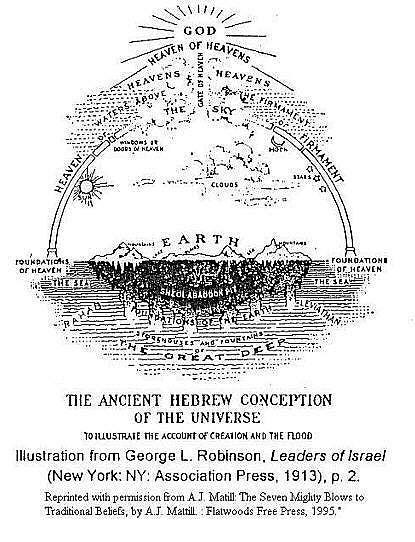
The sun, moon, and stars travel on tracks across the underside of the dome.
Joshua chapter ten contains the famous scene in which the sun stands still in the sky during a battle. The text is not vague. It says the sun “stopped in the midst of heaven and did not hasten to go down for about a whole day.” The Hebrew authors took this to be a real, supernatural pause in the daily motion of the sun across the dome above. It is a coherent miracle inside their cosmology, in which the sun is a luminary moving across a track in the sky. It becomes pure incoherence in modern cosmology, in which “stopping the sun” would actually require stopping the rotation of the Earth itself, with consequences that would liquefy every standing structure on the planet.
The same flat-Earth picture is reinforced in the New Testament.
When Satan tempts Jesus in the wilderness in Matthew chapter four and Luke chapter four, he takes Jesus to “a very high mountain” and shows him “all the kingdoms of the world” at once. This visual works only on a flat Earth. From any point on a sphere, even from the top of Mount Everest, you cannot see all the kingdoms of the world. The line is not edited out by either Gospel writer because they shared the same cosmology as the rest of their world. The sky was a dome. The Earth was a disc. From a high enough mountain, in their picture, you really could see everything.
How could the cosmology of the Bible look so identical to the cosmology of every neighboring culture if the text were divinely revealed?
The answer is that scripture inherited the universe of its surroundings.
Babylonian cosmology, recorded in cuneiform tablets centuries before the Hebrew Bible was written, describes the same model. A flat Earth resting on a watery abyss, covered by a metallic dome through which the celestial bodies travel, and a vast cosmic ocean stored above the dome. Egyptian cosmology imagined the goddess Nut as the dome itself, arching over a flat earth-god below. Canaanite texts describe a near-identical structure. The biblical writers were not innovating a new picture. They were drawing the same picture every literate person in their region drew.
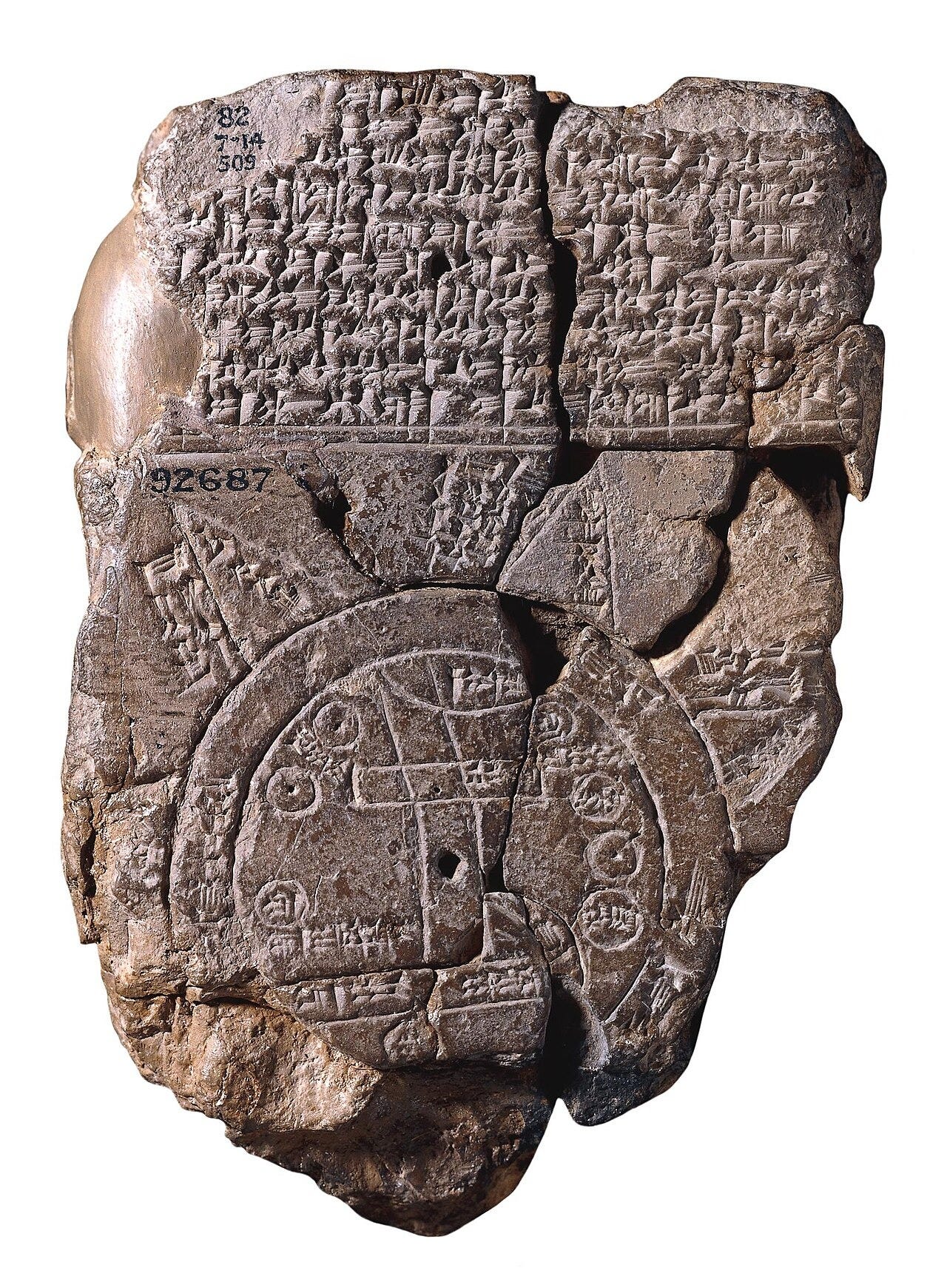
Modern theology has spent two thousand years quietly rewriting these passages into metaphor as scientific knowledge advanced. When astronomers began to demonstrate the spherical Earth, the “four corners” became cardinal directions. When meteorology mapped the actual water cycle, the “windows of heaven” became picturesque shorthand. When astrophysics described the stars as distant suns, the firmament was reinterpreted as the atmosphere. None of these reinterpretations are present in the original text. They are retroactive softenings designed to keep an ancient document from breaking on contact with telescopes.
The biblical universe did not begin as a description of the cosmos we now know. It began as the standard Bronze Age picture of a flat Earth covered by a metal dome. It evolved through prophetic and poetic literature that took that picture for granted. It was decorated with miracle stories that only make sense inside that picture, including a stopped sun and a globally visible mountaintop. And it was ultimately re-marketed, two thousand years later, as compatible with a science it never anticipated and never described.
Recognizing this cosmology does not have to destroy whatever moral or spiritual value a person finds in scripture. But it does require us to be honest about the prescientific, regional, and culturally borrowed picture of the universe that still sits underneath the text we are told is timeless.
Sources & Further Reading
The Lost World of Genesis One: Ancient Cosmology and the Origins Debate by John H. Walton (An evangelical Old Testament scholar’s careful explanation of the Hebrew cosmological framework behind Genesis).
Inventing the Flat Earth: Columbus and Modern Historians by Jeffrey Burton Russell (A historian’s deep treatment of how cosmological models in scripture were understood and reinterpreted over the centuries).
The Cosmology of the Bible (essay collection) by Paul H. Seely, Westminster Theological Journal (A series of academic articles documenting the firmament, the cosmic ocean, and the flat-Earth language of the Hebrew text in detail).
You will never see a collection plate passed around here for ten percent of your hard-earned money. This historical information should be accessible to everyone. But if you are able to chip in, a monthly subscription of exactly $6.66 is a great way to support.